
1971 Penny Value
I have a 1971 D silver penny that I got in a role of pennies. I know there are a lot of plated coins out there from the research I done, but this one looks like it could be real. I did find a website and it said to look for any copper especially around the edges of the penny and there was none. Rare 1971 NEW PENCE 2p British coin worth $5,000. Watch; Extremely Rare 1971 new pence 2 Coin. Penny values are determined using a step by step method. How much your old penny is worth ranges from 2 cents for wheat pennies to thousands for early and rare colonial era cents. Steps identify, series, dates, and mintmarks. Condition is graded comparing to images, video, and descriptions. The 1971 Penny is extremely common, as is the 1971 2p coin. The Mirror (and several other papers) printed completely cocked-up stories about this about a year ago. They triggered a deluge of insane attempts to sell them at ridiculous prices on Ebay. (The one that said 'Mega-rare 1971 2p coin - only £500 - I have 25 of them!' Coin value - penny 1979 (1971-1988) bronze 1 P / Stylized bird EIRE / 1979 / Celtic Harp Coin value - penny 2000 (1988-2000) cooper plated steel.
<- Click Here to go back to the other Coins in Circulation page
The 1p was first issued in 1971 (although 1971 coins were actually made available earlier in blue folders to enable the public to become familiar with them). With the two pence, it is one of only two denominations that has been made to the same size specifications from decimalisation in 1971 right up to the present day.
Specifications are shown at the bottom of this page.
Obverse Type 1, used 1971 – 1984 (bust design by Arnold Machin):
Reverse Type 1, used 1971 – 1981 (design by Christopher Ironside):
Edge: Plain.
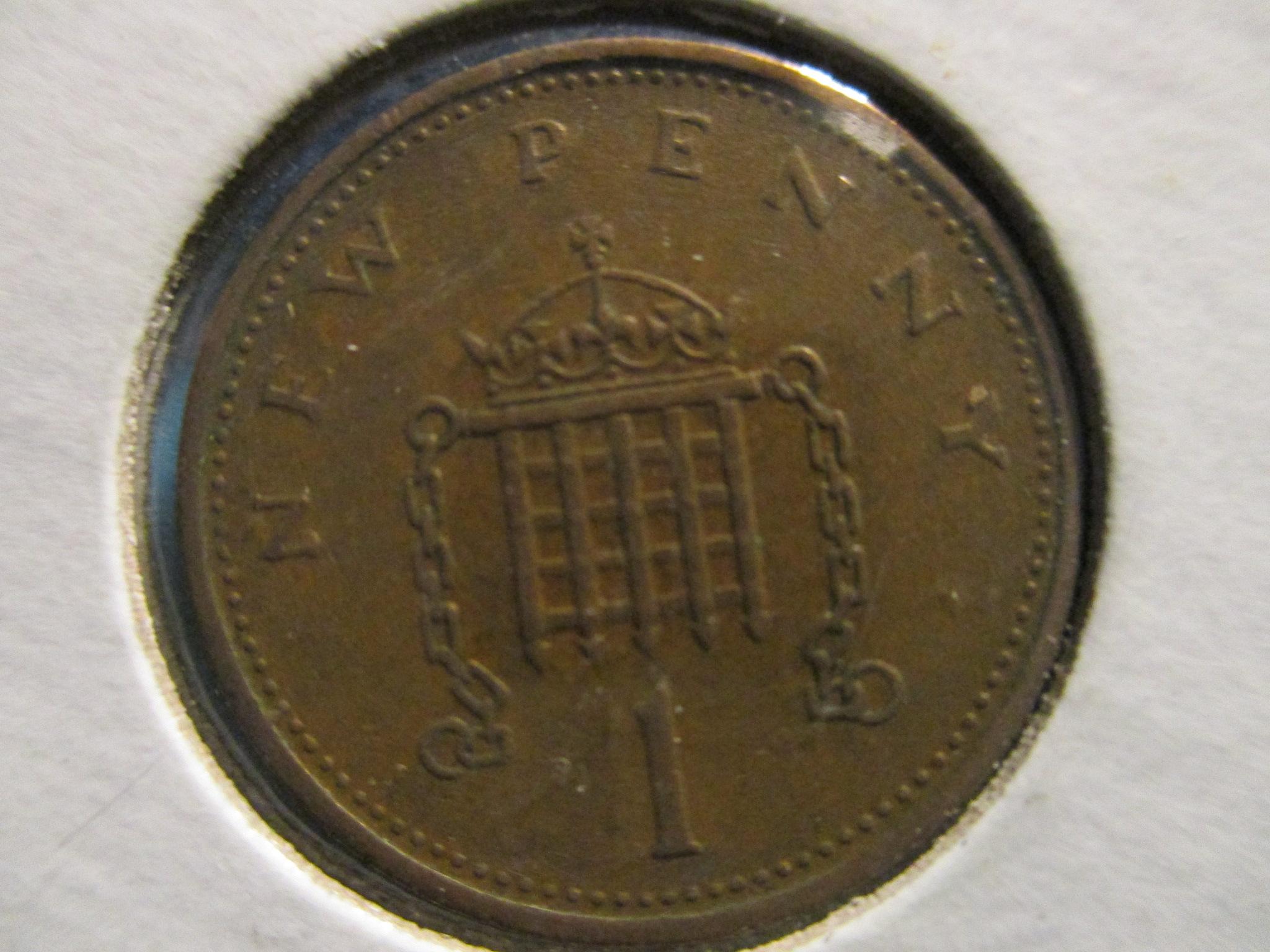
The design:
A portcullis with chains, royally crowned. ‘NEW PENNY’ above, ‘1’ below.
Dates:
1971, Mintage 1,521,666,250.
1972, None for circulation, an unknown amount for annual proof sets only.
1973, Mintage 280,196,000.
1974, Mintage 330,892,000.
1975, Mintage 221,604,000.
1976, Mintage 300,160,000.
1977, Mintage 285,430,000.
1978, Mintage 292,770,000.
1979, Mintage 459,000,000.
1980, Mintage 416,304,000.
1981, Mintage 301,800,000.
Collectability/Scarcity: 1 for the high mintage coins, 2 for 1972 (for scale details see here)
Obverse Type 1, used 1971 – 1984 (bust design by Arnold Machin):
Reverse Type 2, used 1982 – 2008 (design by Christopher Ironside):
Edge: Plain.
The design:
A portcullis with chains, royally crowned. ‘ONE PENNY’ above, ‘1’ below.
Dates:
1982, Mintage 100,292,000.
1983, Mintage 243,002,000.
1984, Mintage 154,759,625.
Collectability/Scarcity (all): 1 (for scale details see here)
Obverse Type 2, used 1985 – 1997 (bust design by Raphael Maklouf):
Reverse Type 2, used 1982 – 2008 (design by Christopher Ironside):
Edge: Plain.
Dates:
1985, Mintage 200,605,245.
1986, Mintage 369,989,130.
1987, Mintage 499,946,000.
1988, Mintage 793,492,000.
1989, Mintage 658,142,000.
1990, Mintage 529,047,500.
1991, Mintage 206,457,600.
1992, Mintage 253,867,000 in plated steel, 78,421 in bronze*.
1993, Mintage 602,590,000.
1994, Mintage 843,834,000.
1995, Mintage 303,314,000.
1996, Mintage 723,840,060.
1997, Mintage 396,874,000.
Collectability/Scarcity: 1 for all with the high mintage numbers, 2 for the bronze 1992 (for scale details see here)
*In 1992 the metal composition was changed from bronze to copper-plated steel (which is magnetic). The coins that went into the annual sets used bronze blanks and all of the coins issued for circulation were made of copper plated steel.
There are also varieties of 1p coins concerning the rivets on the portcullis (click on the picture above for a larger version). It seems that for some years the coins in the BU sets (and proofs) were struck using different dies, resulting in two different types. There is more information here: http://www.predecimal.com/forum/topic/8211-portcullis-varieties-on-decimal-penny/
The following has been observed:
1971-1985*: All coins have left reverse with dot rivets.
1986: Circulation coins had the dot rivets, coin in sets had the right image circle rivets.
1987: All have the dot rivets.
1988, 1989 and 1990: Circulation coins have dot rivets, coins in sets have circle rivets.
1991: All coins have dot rivets.
1992: Circulation coins have circle rivets, coin in sets have dot rivets.
1993: Circulation coins have dot rivets, coins in sets have circle rivets.
1994-2006: All have circle rivets.
2007 & 2008: Circulation coins have dot rivets, coins in sets have circle rivets.
2008 and later: Coins no longer feature a portcullis design.
It is very likely that some of the coin types that were only released for general circulation are now harder to find in Uncirculated condition, and although they are not widely collected, they should probably be slightly higher on the Collectability scale.
*Earlier coins with ‘NEW PENCE’ (1971-1981) appear to have a different dot rivet reverse, which has a small gap between the 5 portcullis vertical bars and the top horizontal part below the crown. More research is needed!
1971 Double Die Penny Value
Obverse Type 3, used 1998 – 2008 (bust design by Ian Rank-Broadley):
Reverse Type 2, used 1982 – 2008 (design by Christopher Ironside):
Edge: Plain.
Dates:
1998, Mintage 739,770,000*.
1999, Mintage 891,392,000*.
2000, Mintage 1,060,420,000.
2001 Mintage 928,698,000.
2002, Mintage 601,446,000.
2003, Mintage 539,436,000.
2004, Mintage 739,764,000.
2005 Mintage 536,318,000.
2006, Mintage 524,605,000.
2007, Mintage 548,002,000.
2008, Mintage 180,600,000.
Collectability/Scarcity (all): 1 (for scale details see here)
*In 1998 and 1999 bronze blanks were used for the 1p coins in proof sets. Circulation coins were made of copper plated steel (as normal).
Obverse Type 4, used 2008 – 2015 (bust design by Ian Rank-Broadley):
Reverse Type 3, used 2008 onwards (design by Matthew Dent):
Edge: Plain.
The design:
The obverse is very similar to the previous but no longer has rim beads. The reverse is the lower left section of the Royal Coat of Arms of the United Kingdom.

Dates:
2008, Mintage 507,952,000.
2009, Mintage 556,412,800.
2010, Mintage 609,603,000.
2011 Mintage 431,004,000.
2012, Mintage 227,201,000.
2013, Mintage 260,800,000.
2014, Mintage 464,801,520.
2015, Mintage 154,600,000.
Obverse Type 5, used 2015 onwards (bust design by (Mr) Jody Clark):
Reverse Type 3, used 2008 onwards (design by Matthew Dent):
Edge: Plain.
Dates:
2015, Mintage 418,201,016.
2016, Mintage 368,482,000.
2017, Mintage 240,999,600.
2018, Mintage not yet known (what is known, is that none will appear in circulation, they can be found in sets only).
2019, Mintage not yet known.
Specifications for all current 1p coins:
Size: 20.32mm
Width: 1.52mm (bronze), 1.65mm (copper-plated steel)
Metal Composition 1971 – 1992: Bronze (97% copper, 2.5% zinc, 0.5% tin)
Metal Composition 1992 – date: Steel core plated with copper.
Weight: 3.56 grammes
<- Click Here to go back to the other Coins in Circulation page
Lincoln Memorial Penny Overview
One of the most well known and longest running series of coins in US history is the Lincoln Memorial Penny. First minted in 1909, the Lincoln cent originally had a wheat stalk reverse, resulting in the nickname of “wheat penny.”
In 1959 the Lincoln cent was updated to replace the wheat stalks on the reverse with a depiction of the Lincoln Memorial. This new reverse was designed by Frank Gasparro and was a way to honor Lincoln, as well as update an outdated design.
The reverse also features the words “UNITED STATES OF AMERICA” centered at the top, with the motto “E PLURIBUS UNUM” directly below. The denomination, “ONE CENT”, can be found directly centered directly below the Lincoln Memorial.
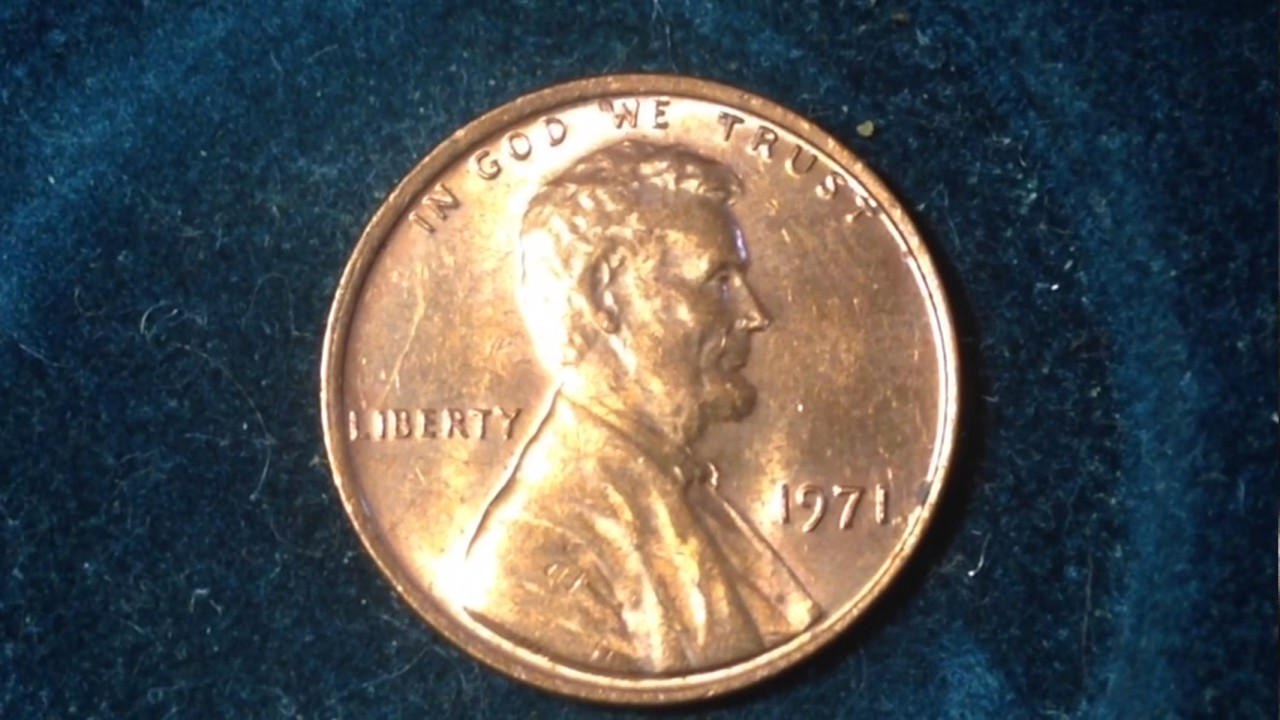
Victor D. Brenner was the designer of the original Lincoln cent, and his portrait of Lincoln has not changed since 1909. Brenner’s obverse design features president Lincoln facing to the right, with the motto “IN GOD WE TRUST” centered above. “LIBERTY” can be found in the left field and the date and mint mark on the right.
Lincoln Memorial cents minted before 1982 are composed of 95% copper and 5% tin/zinc. All cents minted after 1982 are made with a new, cheaper composition of 97.5% inner zinc layer and 2.5% copper coating.
If you want to learn more about the Lincoln Cent or other rare and collectible cents, be sure to read our Ultimate Guide to Pennies.
History of the 1971 D Lincoln Memorial Penny
Although not that much different from prior Lincoln Memorial pennies, the 1971 D penny does have some interesting characteristics compared to other dates in the series.
1982 Penny Value
One of these interesting characteristics is that most 1971 D Lincoln Memorial pennies have a full and very detailed strike. This is due to the mint using stronger dies during the minting process that resulted in a cleaner and more detailed strike.
The “D” next to the date signifies that this coin was minted in Denver. During 1971, the Denver mint produced 2,911,045,000 examples to help meet consumer demand. This number is smaller than most years after 1982 because of the high cost associated with minting a penny.
Like all other Lincoln Memorial pennies, the 1971 D has a diameter of 19.05mm and weight of 2.5 grams. No reeding can be found around the edge of the coin.
The 1971 D Doubled Obverse
Be sure to take a close look at your 1971 D Lincoln Memorial penny to see if it exhibits a rare mint error. This error can potentially make your coin more valuable, depending on its severity and the coin’s condition.
The error that can affect the 1971 D Lincoln Memorial penny is known as a Doubled Die, which occurs when a coin is struck with a die that has a doubled image. This causes certain elements of the coin appear to overlap.
With the 1971 D Lincoln Memorial penny, the doubling can be seen on the obverse in the legend “IN GOD WE TRUST.” In most cases, the doubling is very subtle and requires some form of magnification to be seen properly.
If you determine that your 1971 D penny has a Doubled Die obverse, be sure to take the coin to a reputable coin dealer for a professional opinion. If the dealer also agrees on the error, sending the coin to a third party grading company will help determine the grade of the coin and confirm the error.
How to Value the 1971 D Lincoln Memorial Penny
Like most modern coins, the 1971 D Lincoln Memorial penny was minted in huge quantities and can commonly be found in everyday circulation. This makes even uncirculated examples worth only a couple cents over face value. Uncirculated examples are only valued at fifty cents.
Although common versions of the 1971 D Lincoln Memorial pennies are worth very little, those that display the Doubled Die Obverse can be worth significantly more.
An average grade 1971 D Doubled Die Obverse is worth about $10-$20. Uncirculated examples with heavy doubling have sold for over $150!
Due to the rarity of this type of error, these coins are not found in the market frequently. This means that the given prices are estimates, and can vary greatly based on collector demand.